

VISIT THE REAL-LIFE CASTLES THAT INSPIRED DISNEY FILMMAKERS
I had to lean in closer to hear what my daughter was whispering into each of the doors we passed at the open-air Norsk Folkemuseum in Oslo, Norway. The museum includes 160 buildings dating back to the Middle Ages, and it didn’t take long for my 3-year-old daughter to see the same things Disney artists and filmmakers saw when they visited the site years earlier looking for inspiration for their new film, Frozen.
“Do you want to build a snowman?” she whispered into each keyhole, pausing slowly before moving on to the next, hoping her next whisper would be the one to unlock the secret of her favorite Disney princess’ true home. We have visited the Disney theme parks and snapped photos with princesses before, but this was the first moment I could tell it felt real for her. That same magic and culture those artists had felt — and then tried to portray in the film — was exactly what she was experiencing, and she left with a deeper understanding of what life in 1840s Norway might have been like for two real-life sisters.
It’s no accident the characters are so compelling and the imaginary worlds are so believable in Disney movies, as the artists and writers often take weeks to travel and find inspiration for bringing their creations to life. The tradition dates back to Snow White and the Seven Dwarfs, when Walt Disney himself traveled to Europe before his first feature-length animated film. The tradition has spanned the decades, and from a château in the Loire Valley of France to a Spanish castillo, these are the real-life castles that laid the groundwork for some of the greatest animated films of all time.
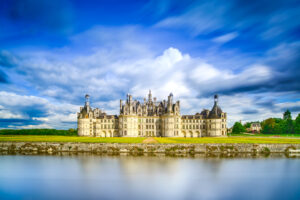
PHOTO: © STEVANZZ | DREAMSTIME
CHÂTEAU DE CHAMBORD
Loire Valley, France
The pointed spires and dramatic rooftop of this French Renaissance château played a large part in the design behind the Beast’s castle in Disney’s 1991 Beauty and the Beast. Like the movie, this château once belonged to a handsome young royal, François I, but unlike the movie, the young king of France didn’t reside there. François I built Chambord in 1519 as a vacation home and hunting lodge and used it to impress dignitaries and sovereigns with its stunning architecture. The central double helix staircase was inspired by Leonardo da Vinci and leads to the rooftop with breathtaking views of the grounds as well as the château itself. Today the château is both an exhibition for celebrated artists as well as a stage for incredible events. Guided tours bring out the château’s most magical secrets, and visitors are allowed to explore its most secluded wings … yes, even the “west wing.”

PHOTO: © ELENATUR | DREAMSTIME
TAJ MAHAL
Agra, India
Agrabah may be a made-up kingdom in the 1992 Disney movie Aladdin, but the palace in the film is a very real depiction of the Taj Mahal. The movie blends pieces from Turkish, Persian and Islamic influences into its storyline, but the sultan’s palace and its uncanny resemblance to this famous landmark is pure India. The Taj Mahal itself was built between 1631 and 1648 as a mausoleum for Mughal Emperor Shah Jahan’s wife, Mumtaz Mahal, who died during the birth of her 14th child. This masterpiece of white marble and precious stones became the final resting place of the emperor and his bride before it earned its rightful place as a UNESCO World Heritage site. Entrance is available Saturday–Thursday, and many visitors recommend arriving before it opens to see the monument in its most dramatic lighting or reserving tickets in advance for one of the rare full-moon viewing experiences.

PHOTO: © AUGUSTIN FLORIAN | DREAMSTIME
ALCÁZAR DE SEGOVIA
Segovia, Spain
Spain’s most visited castle gets the credit as the inspiration for one of Disney’s first — and most sinister — characters’ royal abodes. The evil queen banishes her stepdaughter from her decadent castle in Disney’s 1937 animated film Snow White and the Seven Dwarfs, where the pointed spires and hilltop perch are more than just reminiscent of the Alcázar palace in Segovia. Disney recently confirmed the claim that Alcázar acted as the blueprint for the design of the evil queen’s castle in the film, and the real-life castle’s storied history as a prison, fortress, temple of royal secrets and palatial residence likely also trickled into the film. Although visitors will discover a similar courtyard to the one in the movie, the closest thing to a magic mirror is the hauntingly beautiful Carlos Muñoz de Pablos’ stained-glass window in the throne room.

PHOTO: © MINNYSTOCK | DREAMSTIME
NEUSCHWANSTEIN CASTLE
Schwangau, Germany
Walt Disney himself visited this celebrated castle with his brother and his wife in 1955, avowing to the castle’s cinematic magic even though it already made it into the plans for Disneyland’s Sleeping Beauty Castlethat opened the same year. The castle’s fame predated his visit and has lived on long after as one of the most emblematic fairy-tale castles in the world. Despite its connection with the park and with Disney’s 1959 film Sleeping Beauty, Neuschwanstein is often referred to as Cinderella’s Castle for its resemblance to the empty castle in Walt Disney World, which is fitting since the eccentric Bavarian king who started designing and building the real castle in 1869 never lived inside and built it as a fantasy kingdom.

PHOTO:© MINNYSTOCK | DREAMSTIME
MONT-SAINT-MICHEL ABBEY
Le Mont-Saint-Michel, France
The picturesque Kingdom of Corona from Disney’s 2010 movie Tangledtook its aesthetic directly from Mont-Saint- Michel, with the magical island winding upward to reveal a gravity-defying castle. The real-life location also winds upward, only the pinnacle of the tidal island’s climb is not a castle but rather a Gothic-style Benedictine abbey. The island itself still supports an active community, inhabited by around 20 Montois residents year-round, and has a post office and a mayor. In the movie, Rapunzel and Eugene take a boat around the island, but the real island is accessible only by foot, whether from the sand during low tide or from a footbridge that makes the island accessible even during high tide. There is no strong connection to any Rapunzel-esque lantern festivals, but an illuminating night show inside the abbey occurs most summer nights.
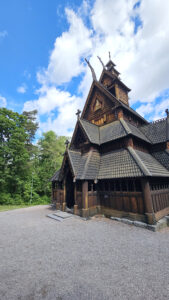
PHOTO: © MARK ALPERT
BORGUND STAVE CHURCH
Oslo, Norway
Norwegian folklore pervades the 2013 Disney movie Frozen, in which Norse trolls and Scandinavian burial customs weave their way through the storyline, but the architecture is also notably Norwegian. The animators visited Norway searching for ideas and found them at the Norsk Folkemuseum in Oslo. The Borgund Stave Church’s angular roof reflects the same style as the castle in the fictional land of Arendelle, and much of the architecture featured in the film pulls from the timbered designs seen throughout the park. Even the outfits the characters wear in Frozen came from real-life folk dresses and outfits on display in the artifact museum. The Borgund Stave Church is one of the country’s best-preserved stave churches; its timber framework — built entirely without nails — has stood unharmed for nearly 800 years.